
When Can a California Notary Refuse a Notarization? Family, Incomplete Documents, and Conflicts
When Can a California Notary Refuse a Notarization? Family, Incomplete Documents, and Conflicts
Last updated: September 15, 2026
California notaries follow strict rules. This article shares information from official sources. It serves as education only. Always confirm current rules in the 2026 Notary Public Handbook, the printable PDF, and cited Government Code sections.
A Relative's Deed or a Blank Form Walks In
Your phone rings. It's your cousin. He needs a quick notarization on a property deed. He arrives with the paper ready to sign. Or consider another scene. A signer pushes a trust document across your desk. Blank spaces stare back from key lines. These moments test every California notary. You need clear rules. Not guesses.
California law draws a sharp line. Some refusals stand as requirements. Others allow lawful choice. Know the difference. It protects your commission.
Mandatory Refusals Versus Lawful Declines
California rules force refusal in set cases. Think incomplete documents or personal financial stakes. These count as mandatory refusals. Fail here, and you risk penalties.
Other times, you may decline. Employer policies fit here. Or personal limits on transaction types. These mark lawful declines. Base them on notarial standards. Never refuse from dislike of the deal's purpose.
Refuse Incomplete Documents
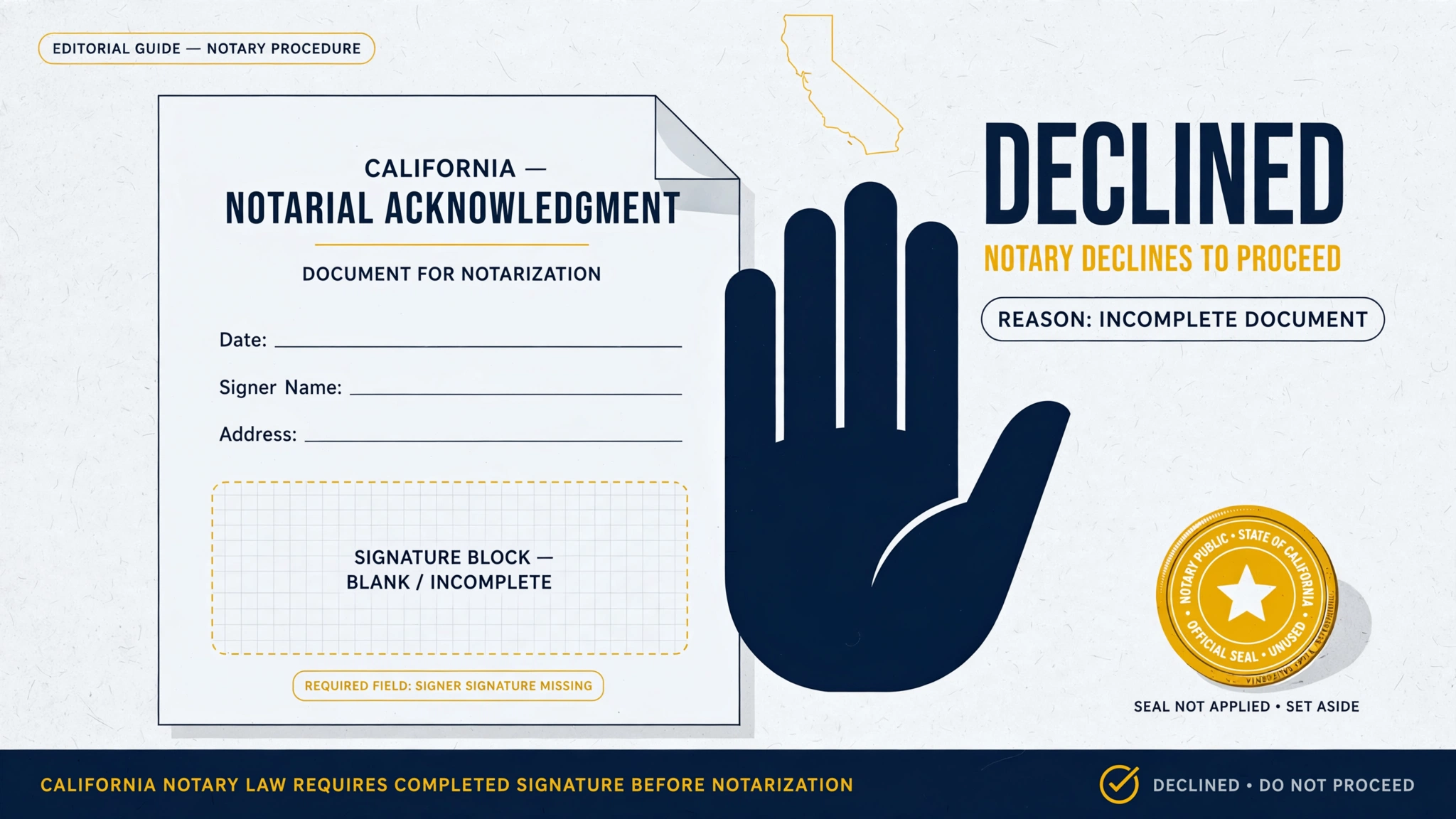
Spot an incomplete document? Refuse the notarization. The Handbook states it plain. If experience shows the form lacks parts, or blanks scream obvious on the face, stop there. Government Code Section 8205 backs this. Fill material blanks before the act. You do not draft. You do not explain legal effects.
Example: A power of attorney misses the agent's name. Or a deed skips the date. These demand completion first.
Direct Financial or Beneficial Interest Blocks You
When Must a California Notary Refuse Due to Conflict of Interest?
A direct financial or beneficial interest forbids the notarial act. Government Code Section 8224 sets this rule. Handbook examples abound. You serve as a principal in the deal. Or you act as grantor, grantee, mortgagor, mortgagee, trustor, trustee, beneficiary, vendor, vendee, lessor, or lessee in real property.
Never notarize your own instrument. See Section 8224.1.
- You gain from the transaction.
- Your stake ties direct to the outcome.
- Refuse. No exceptions.
Can a California Notary Notarize for a Family Member?
Family ties alone do not bar you. The Handbook permits notarizing for relatives. Unless a direct financial or beneficial interest arises. Take extra care with a spouse or domestic partner. Community property laws add risks. Assess each case. Refuse if your interest disqualifies you.
Your brother needs a loan document signed. No stake for you? Proceed with standard checks. But if the deal benefits your wallet, decline.
Other Required Refusals
More stops exist. No personal appearance? Refuse. Identity fails satisfactory evidence rules? Stop. See the full ID rules in our ID rules article. Signer seems unclear or unwilling? Decline.
Employers set limits too. Government Code Section 8202.8 notes workplace constraints. Honor them as policy, not state mandate.
Stay Clear of Unauthorized Practice of Law
Refusal ties to professionalism. You judge notarial fit only. No legal advice. Read our UPL article for details. Stick to the script.
Script Your Refusal and Journal It
Keep it calm and factual. "I cannot complete this notarization. The document remains incomplete." Or "I hold a disqualifying interest."
Journal the request if no act follows. Check practices in our appointment workflow article.
Renew and Stay Sharp
Renewing notaries face these rules on every exam and job. Take the state-approved 3-hour course at $69.95. Get an instant certificate. Access 300+ practice questions. Chris Morgan leads it. We'll refund every penny if needed.
Master refusals. Protect your path.
Written by Chris Morgan
Expert Notary Advisor at The Notary Public Institute
Ready to Start Your California Notary Journey?
Don't leave your commission to chance. Join thousands of students who trust The Notary Public Institute for the most comprehensive, easy-to-follow training in California.
Stay Ahead of California Notary Changes
Join our community of 5,000+ notaries. Get state-level updates, compliance tips, and career resources delivered to your inbox.
Related Articles
California Notary Name or Address Change: Deadlines, County Transfers, and Seal Updates
California Notary Name or Address Change: Deadlines, County Transfers, and Seal UpdatesLast updated: September 15, 2026Picture this: You perform a notarizati...
Read ArticleCalifornia Notary Bond vs. E&O Insurance: What the $15,000 Requirement Covers
California Notary Bond vs. E&O Insurance: What the $15,000 Requirement Covers Last updated: September 15, 2026. Always confirm current bond filing rules ...
Read Article